Friday, February 15, 2013

October 20 Home


Oct. 20

We got up early today, Robert left before the rest of us, Paul, Raquel, and I took a very crowded and unsteady bus ride to the airport at 8:00.  We all said good-by and began the long trip home.  I had a 9 hour flight to Atlanta, a 4 hour lay over where I am now and I still have a 4 hour flight to SLC.  It is good to be back in the states.  I have cell phone coverage again and have talk to Holly.  I had a cheese burger, and saw the first drinking fountain that I have seen in three weeks.  Just a few more hours and I will be home to my family and my own bed.  I left the Hotel at 8 in Brussels and should arrive in Utah at 9, home by midnight I hope.  With the time difference it will be 24 hours of travel.

October 19 Brussels


Oct. 19

Our last day in Europe!  We began the day by visiting the DBV office and hearing a presentation from Tiffanie Stephani, she is over environmental issues for the DBV which is a major concern with the EU Ag policy.  She explained how the EU works, and the challenge of lobbying here in Brussels.  The DBV has 6 staff members in Brussels, they figure about 90% of Germany's Ag policy is decided in Brussels.  The EU has more impact on agriculture in Germany than the German government.  All German states and farming organization also have representation in Brussels; most farm organizations are housed in the same office building to make it easier to coordinate their efforts.  She spoke about most of the same issues we have heard before.  Her opinion is that most German farmers are not in favor of the EU because most do not understand what the EU does for them.  Willie Kampmann stepped into the meeting and stated that about 1/4 of all German jobs are related to the export market and 70% of exports are to EU countries.  He claims it is very important for German Ag to have an equal currency (the Euro) and open access to EU markets.  He did admit that it has been very difficult to create one currency with 27 different financial policies and those are still trying to be resolved

We next went to the EU Parliament where with visited with Dr. Andreas Schneider, he is the main agricultural adviser for Parliament, and is involved with most Ag policy development.  Again we talked about many of the same issues that we have been discussing for the last three weeks and especially with all of the people we have met with here in Brussels.  It appears to me that farmers all over face many of the same issue, the interesting thing is to see the different approaches to salving those problems.  Germany tends to look for the government to help them out and expects government payments to maintain profitability.  They are trying to do away with supply controls and trying to evaluate more equitable ways to disperse farm payments.   Dr. Schneider was interested in our crop insurance programs, there is some support to create a similar program, he is not in favor of the idea but had several questions.


We had lunch in the parliament cafeteria, the food was not very good, and it was very crowded.  I would not recommend it.  We then went on a 3 hour walking tour with a tour guide that spoke very little English and I think understood even less.  It was the longest afternoon of the trip.  We figure that we walked over 5 miles, by the end we are all worn out.  Paul hailed a taxi and left less than half way through, the rest of us wished we had gone with him.

We had our final dinner with Tiffanie at a little restaurant in down town Brussels.  It was a sea food palace which made everyone but me happy; I did have a good lamb dinner though.  We said goodbye to Robert who leaves early in the morning before the rest of us.  It has been a good trip, once in a life time, but we are all starting to talk of home and it is time to go.

October 18 Brussels


Today we left Germany and made our way to Brussels, the Capital of the EU.  I think we were all a little disappointed not nearly as nice a city as we expected.  

We started the day with Dr. Lutz driving us to the train station where we went from Bonn to Cologne.  We got off at Cologne to walk through the cathedral, a massive old Catholic Church located right next to the train station.  Like all the other churches we have seen it was amazing, large stain glass windows and paintings.  But with all the visitors coming and going the picture taking and other distractions they seem to lack the reverence I expect to feel in at church.

After an hour stop we hoped back on the train and finished our trip to Brussels.  Upon Arriving in Brussels we were to be picked up and taken to our first appointment, but we could not find our ride.  We finally got a taxi to take us to our hotel where we were able to contact the DBV and make arrangements to be picked up.  It was a simple case of missing each other.  Willi Kampmann, who we had lunch with on Sunday was waiting for us on the train platform.  We got off the train went straight down the stairs and waited at the front of the station.  We never saw Willi, and he never saw us.  He did finally find us at the hotel.

In Germany not only do they have a national government in Berlin to deal with, they also have to the European Union located in Brussels.  The last part of our trip will focus on understanding the EU and its relationship to Agriculture.

We first met with Roger Waite, European Commission spokesperson for Agriculture and Rural Development.  Mr. Waite is originally from England, it was very different to talk with a native English speaker after three week in German.  He spoke about and their policies toward agriculture.  Today 40% of the EU budget goes to Ag, in 1960 it was 80%.  25% of the budget is for Rural development Programs, "the programs are for everyone, but are delivered by the farmers."  One of the concerns they have right now is a change to the political process of the EU that they call Co-Decision.  In the past the Council of Ministers had final say on all Ag policy, the recommendation from Parliament was non binding.  Under the new process Parliament and the Council must both agree on the policy before it will be passed.  It is unsure how this will affect agriculture, it will certainly slow down the decision making process.  He also talked about the history of Ag programs.  In 1992 price support programs were reduced and a direct payment program was started.  In 2002 the direct payments were no longer linked to production, instead a flat rate per hectare, or per animal was adopted .  Today they are talking about requiring 30% of Farm payments to be linked to "greening" programs to increase crop diversity and protect the environment.  They are also talking about capping payments to individual farms (large farms).  Also creating incentives for young people to get started with farming, possibly a 25% higher direct payment for the first 5 years.  The challenge for EU farmers, like US farmers is to produce more with less.  In Europe this will have to be done without the use of GMO products, that debate has already been lost to public opinion.  A good discussion Mr. Waite is very down to earth and really tried to help us understand the EU Ag policy and political debates at this time.     

We then had dinner with Maurice House, USDA Minister-councilor for agriculture.  Mr House has been with the USDA for over 28 years and has worked in several different countries, he not works in Brussels with the EU.  He is very outspoken and somewhat critical of the European attitude towards US agriculture and GMO crops.  His job is to develop opportunities for US Ag products to be sold in European markets, today we have very limited sales in Europe.  A few high end products such as t-bone steaks.  One of his biggest grips with the EU is that they take away consumers choice and mandate what products they can buy, no choice about Bio-tech, it is just not available at any price.

October 17 Bonn


Today was a day of sight seeing with Dr. Klaus Martin Lotz.  He is the former officer for international relations for the DBV.  He has worked with many McCloy groups over the years and wanted to take us around.  He is a funny older man with a crazy laugh.  I think we wore him out; he seemed tired by the end of the day.
Photo

We first went to the Rhineland cultural heritage open-air-museum, a museum of traditional German homes from the different time periods over the last 300 years.  It was interesting for the first little while, but after nearly 3 hours I was ready to go.  We did see a very interesting wind powered grain mill.  The entire mill could be turned in any direction so as to face the optimal direction to capture the wind to power the mill.  It was amazing to me to see the construction of such machine with the technology they had at the time.  We had a very good lunch in the little restaurant that was part of the museum.  Fried potatoes and sausage, simple but very good.


From there we went to the wine growing region.  I never cease to be amazed at the way they raise the grapes on such steep hill side, often they have to build rock walls to keep the trees from sliding down the hill, buy the grapes do very well.  We toured a security bunker that the German government had built in an old train tunnel during the Cold War.  It as a little interesting but an hour and half tour was about an hour and twenty minutes too long.


We did have a very interesting conversation with our host.  He told of his memories of seeing the sky filled with planes flying over to bomb German cities during the war.  He also told of his father being taken away by American troops (he later returned).  His fear is that we will get into another world war with Iran.  It was very interesting to hear the perspective of a man who remembers first hand the horrors of war in his own land.

Tomorrow we are off to Brussels, our last stop before heading for home.  It is hard to believe we have seen so much in three weeks, at the same time it is hard to believe we have been here for three weeks and the trip is coming to an end.


 Stefan Metzdorf, Garrick, Raquel, Paul, Robert, and Matthias Mehner

October 16 Bonn


Today we saw some things that we have not yet seen on our trip.  We started with a tour of Otto Schmitz-Hubsch, a large apple and pear orchard.  They have nearly 80 acres of orchards with many different varieties of apples, and a few pears.  Apples are their largest crop with about 15% of their apples going for juice and the rest being sold in their own store.  They don't sale any products outside of their own retail store.  We were surprised that they can be successful selling that large of volume of apples in a store that predominantly just sales apple products, but the whole time we were there the store was busy.  It was interesting to see them picking the apples.  All the apples are covered by hail covers, white retractable coverings that prevent the hail from hitting the apples while allowing rain and sunlight in.  The trees are only allowed to grow about 8 ft tall so all the picking can be done from the ground, no latters.   Some of the apple had stickers placed on them which cases them to stay yellow on those spots while the rest of the apple turns red, leaving a design, a smiley face or a hart for example. 


We decided that they have the same problems as we do in America when it comes to forecasting the weather, it was supposed to be sunny today but it rained most of the morning and was cold and windy in the afternoon.

In the afternoon we visited a large large tree nursery, Wilhelm Ley.  They raise nearly 300 varieties of trees on 1100 acres of land.  Their trees are harvested and sold all over Europe.  We were taken on a tour of the farm and watched the workers dig up and "bale" trees in preparation for sale.  It was a fascinating process, a team of four people, and the right equipment, could do one (20 foot) tree in about 4 minutes.  We were all fascinated by the process and impressed by the efficiency with which they worked.  We also visited their Garden Centre, a large store that not only sold their trees and shrubs, but also many other items from clothing and home decor to a small coffee shop.  A very interesting store that was developed as a way to market their trees but has now grown into a separate business all of its own.  Again the store was busy the entire time.

Tonight Sefan took us to dinner at Hofgarten restaurant in Derneu (just outside Bonn).  We had an authentic German dinner in a old time German small town setting.  Narrow Cobblestone Street, beautiful shops and homes on each side.  We ride in Stefan's Scoda car that was never intended to hold five adults, we laugh as we squeeze into the back seat, Stefan is a good sport about it and laughs along with us, he was comparing it to a sardine can today.  We will see Stefan at breakfast in the morning but will not spend any more time with him after that.    

October 15 Bonn


Oct. 15

This morning we met with our host Stefan, his office is connected to the hotel.  He gave us a presentation on about an International Education Exchange, the program that his office coordinates.  They help to place about 130 German students in other countries each year (50 in the US), and place 100 international students in Germany.  The students are post high school and are place with a farm where they can work and learn first hand about a particular agricultural industry.  He asked Matthias Schulte-Althoff to tell about his exchange in North Dakota.  He worked on a wheat and cattle farm, he said that the size and scale of the farm was unlike anything he had seen.  It seemed to be a great experience for him.  His family has hosted several exchange students from Eastern Europe and plans to host more in the future.  The program seems to be a great experience and Stefan is always looking for students who would like to participate.

We also listened to a presentation from Matthias Mehner who is in charge of the "Central National Institute for Advanced Vocational Training".  They have developed a leadership development program that focuses on social training for farmers and Ag leaders.  The Program is called B/U/S and costs 100-300 euros per session.  The sessions are each two days long and include:
  1. My own capabilities
  2. My enterprise and market
  3. Communication
  4. My way forward (mission statement)
  5. Project and time management
  6. Negotiations
  7. Corporate development (goals for the business)
  8. Capital expenditures (finance)
  9. Work-life-balance (values)
  10. My individual development concept
We drove in Stefan's tiny car to the city center where we walked around and saw the community building where Ronald Reagan met Mikhail Gorbachev.  We then had lunch at a restaurant close by.


We then rushed to our next meeting at the office of the Rheinischer Landwirtschatsverband (Rhineland farm Bureau).  We visited with Dr. Reinhard Pauw the managing director about the purpose of the RLV, they are much like our Farm Bureau.  We also visited with Aline Foschepoth, an agricultural engineer.  Her group works with farmers to mitigate conservation requirement.  In Germany when land is developed there must be half as much land as was developed placed in conservation to preserve wildlife habitat.  Traditionally land was place in forest and was lost to agricultural production forever.  This group is developing ways to preserve wildlife habitat and maintain agricultural viability of the land at the same time.  Some of the examples we saw included planting grain in wider rows to allow for birds to nest in between the rows, also leaving small unplanted patches throughout the field (20X10) also to allow for nesting.  It appears to be an interesting approach to conservation and preservation of wildlife habitat in this high population density country.


Following our meetings we were driven back to our hotel and given some free time.  We are getting towards the end of our trip and must be getting tired because we sat in the hotel lobby and talked for a while before going to bed.  We talked about going out to eat or see the city, but nothing appealed to us.

October 14 Bonn


Oct. 14

Today is Sunday, my last Sunday in Germany.  We rose early to get the train this morning.  We left our hotel at 7:00 and drove to Saarbruiton and caught the 7:50 train headed for Bonn.  We enjoyed a beautiful ride along the Rhine River, one of the most pretty train rides we have had, it will also be our last train ride of the trip.  We arrived in Bonn about 11:30 and were met by Stephan Metzdorf, a McCloy fellow from last year,   and also Dr. Klaus Martin Lotz, Former director of international relations for the DBV, Dr. Lots has worked with many McCloy groups and still enjoys meeting with them every year.  He told stories about several of the groups he has hosted in the past and even remembered Leland Hogan coming with the first McCloy group 32 years ago.

We were joined for lunch at a nice Italian restaurant by Willy Kampmann, Head of the DBV office in Brussels, we will be with him later in the week.  This afternoon we went to a multi-generational housing complex where Stefan, his wife (who is out of town) and their young son live.  It is an interesting mix of older citizens and young families.  They share many common areas such as a laundry room, a work shop where they share tools, and a large dinning room.  They each have their own separate apartment were they have their privacy.  We had coffee and cake with his neighbors and had a very fun visit.  The apartments overlook the cemetery where Beethoven's mother is buried.
We got to our hotel about 5:30, we are all so tired are glad to have some time to rest.  I can't seem to get the internet to work for me, it works great for everyone else but apparently it doesn't like me.  Bonn is the former capital of West Germany and still has a lot of government offices and even some EU and international offices.  It should be an interesting few days here.  Stefan only has a small car so I hope we don't have to drive very often.  Paul, Raquel, and I are getting a little too well acquainted stuffed in the back seat; I can't even put my head up straight.

October 13 Saarland


Oct. 13

We stared the day by visiting Globus, a large supermarket store, I would compare more to a Walmart, they sold everything.  We specifically visited to see their bucharie, they cut all their own meat and sale it fresh daily.  We were taken to the back were they had about 12 people cutting meat, 8 bulls and 30 hogs per day plus turkey.  Globus is a large chain of stores; each one cuts their own meat.  The display case must have been 150 ft long with every kind of fresh meat you can dream of, and at 10:00 on a Saturday morning it was the busiest place in the store.  When kids visit the store they are allowed to go the the counter and get a free sample of cold sausage, they walk around the store eating it like candy.  I don't particularly like the cold sausage, maybe I am just getting tire of it, but we get samples every time we visit a bucharie, this time the "sample" was nearly a 1/4 lb.  It was an interesting visit not only to see the meat department but also look around the rest of a German store.  A Large Backerie, cheese case, and one of the largest wine and liquor sections I have ever seen.  I did look at the price of milk; it ranged from E .50 to E 1.05 per Liter (I'll have to run the conversions later).  As near as we could tell the meat was about 3X what we would pay in America.


We then traveled to Trier, the oldest city in Germany. The city was first settled in 16 BC by the Romans.  One of the original Roman gates remains to this day, one of just a few in the world.  We had an English tour guide who told of the history of the city and showed us a couple of cathedrals one of which is supposed to house the garment that Christ wore when he stood trial.  They are massive and beautiful, it makes you wonder how they built them with the tools and technology they had at the time.  No nails or mortar, just stone on stone and they have lasted 2000 years.


On our way back we stopped for a short look around Saarburg, and then for a short tour of an old tie stall dairy (30 cows).  The highlight of this dairy was the old distillery, once again free samples for all who were interested.


The Highlight of the day was a dinner and wine tasting at Schloss Thorn, a large wine estate, with Dr. Baron Von Hobe-Gelting.  While I did not taste the wine the conversation and story telling by Dr. Hobe-Gelting was quite enjoyable.  The Vineyard has been in his family for 800 years, it has been rebuilt at least three times due to different wars in the region.  It was evacuated twice during WWII and was used by General Patton's army for some time.  In the 800 year history of the vineyard there has been nearly 400 years of war.  The conversation covered the history of much of Germany and then turned to politics where Dr. Hobe-Gelting voiced his concern with the Green movement and their anti business, anti freedom agenda.  He claims that their world view doesn't have a plan for marketing, they want to legislate things that the market would never allow because they make no sense.  They want to pass laws because it give them power.  When a few people get an idea if they can convince enough people (through their own ignorance) that the idea is right then they gain power over the society.  Example the Nazi movement of the 1930's.  He further talked about the Muslim world and how they have learned that by stifling education they can control a people and the best way to do that is to not allow women to go to school.  When women are educated children become educated and the power of the ruling class is diminished.  He did express hope for the future by talking about former eastern Germany, he told of traveling to east Berlin for business and seeing the armed guards watch the trains so no one could escape on the sides of the train to the west.  The people tolerated the loss of freedom for a while before demanding Freedom and doing what was necessary to gain their freedom (thanks to a little help), he thinks it will just be a matter of time before the people wake up again to understand the freedom they have given away.  Very interesting discussion with a very refined gentleman.


 We finished the day with a stop at Oktoberfest.  Crazy, that is the best way to describe it.  People of all ages drinking beer (lots of it), and dancing, often on the tables.  We got back to the hotel about 12:15.


October 12 Saarland


We began the morning with a visit to the John Deere combine and harvester factory in Zweibruecken.  We listened to a short overview of the John Deere Company as a whole and the Zweibruecken plant specifically.  Then the fun part, we had a two hour tour of the factory and saw the construction of the machines from start to finish.  I learned that they do not start building either machine until they have an order from one of their dealers.  However once they start they can ship a combine in 12 days and harvester in 7.  If was amazing to watch the lasers cut with precision and the robots weld and bend the raw steel into finely shaped parts that fit perfectly together.  Our guide was a funny older gentleman who had worked at the plant for 39 years and knew the place inside and out, he had us laughing through much of the tour and dinner afterwords.  The only thing we were disappointed in was that we were were not allowed to take pictures.  We eat lunch in their cafeteria before leaving.

 From there we drove to Rittershof 2, a hog and beef farm.  The have an inclosed hog barn, we were required to wear disposable coveralls and boots in the barn.  The hogs are raised from 30 kilo's to about 120 kilo's in small pens, first 24 to a pen and as they get bigger the number is reduced to 12 per pen.  The hogs are purchased as babies from a large breeding farm and sold to local butcharies.  About 240 hogs at a time on this farm.  They raise and mill their own grain, but buy soy for protein.  There are also about 20 Limousine cows and calves raised mostly on the pasture.  As seems to be normal the cows are watered using a mobile water tank with a few small water bowls.  The tank is always small and we wonder how the cows get enough water, but it seems to work, the cows looked good.


Next we visited an organic livestock farm.  The main enterprise is a dairy where they bottle milk and yogurt for the local market.  The market is so good that they have to buy milk from other farms, and think they could still sell more if they had the milk available.  They also raise a few hogs for sausage and have started to raise chickens in a new 30,000 E (capacity 200) mobile chicken house.  The chickens are free range and can be seen by the community as they walk and drive past the farm.   They have a small farm store on the farm, as well as a self serve farm stand where people take what they need and pay on the honor system.  They also sell in a vending machine and at local grocery stores.  They seem to do a very good job of marketing and taking advantage of a market that is alive and healthy here.  They sale eggs for approximately $7 dozen (they are actually sold by the egg) and milk is .38/L as compared to .27/L for conventional.


We finished up the day by visiting the home and farm of our host, Peter Hoffmann.  Peter has a dairy farm of about 90 cows and farms 120 hectares.  He also raises a small amount of fruit and has 2 distilleries where he makes shnops and liquor.  Everyone seemed to enjoy the free samples.  We had an excellent dinner of schwenker, Marinated pork cooked over a fire of beech wood.  Quite possibly the best meal yet in Germany.  
 

October 11 Black Forest


Today was our last day with Thomas, we started a little late this morning, we all needed a morning to relax and sleep in a bit.  Before leaving we walked across the street from the hotel to the Butcher shop where the owner of the hotel was, he gave us an impromptu tour of his shop.  I did not get his name, but I have never seen someone so excited about his job.  He took us right back to where they were making the sausage and showed us how they smoke the meat and gave us many samples of fresh sausage.  He has a very good reputation, easy to understand from the samples, and does a very good business.  Even though he is the owner and manager of the hotel, restaurant  and butcher shop, he still cuts the meat everyday, and loved to share it with friends.


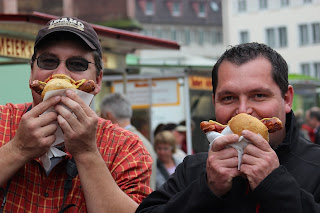
About 10:30 we continued our journey through the Black Forest, the weather was still overcast, but not as bad as the day before so we could see the forest better, we stopped a couple of time for Robert to take pictures along the way.  We traveled to Freiberg to catch the train, but not before walking around the town and visiting a 900 year old catholic cathedral.  In this are they have a farmers market each day with many venders setting up shop to sale their produce and hand crafted goods.  I counted at least 12 sausage vendors, and all were busy.  We each had bratwurst on a bun for lunch, the bratwursts were much larger than the buns.  We walked around for nearly an hour looking at the cathedral and seeing the different vendors at the market.  Of all the thinks for sale I believe the sausage was the most popular, everyone getting a sausage for lunch.  The German people seem to have a different taste preference than I do.  The sausage is good, in moderation, but it is often eaten by its self with little to go with it, no chips or French fries, and very hard to find something sweet for desert.


We also visited with Anna, the PR director at the DBLH at their office.  It is always interesting to visit with then about Ag issues, they seem to be very similar to the ones we have.  The disconnect between the consumer and the farmers, and how can we influence public opinion of farmers.  They don't seem to have any more answers than we do, but in some ways I believe they are fighting a tougher fight with public opinion of bio-tech and environmental issues.  We should try to learn from their mistakes on these issues.  Paul keeps bringing up an important point in the discussion which is often overlooked, He asked what is our goal in regards to public policy and public perception in regards to Ag?  Often the policy actually has the opposite effect in regards to our desired outcome, and we must ask ourselves, do we really want what we say we want?  He advocates for essentially two systems, one that mass produces food, and one that produces food in a manner consistent with consumer preferences to feel the niche markets.  I believe to some extent this is happening, maybe more so in Germany that in America.  The German people seem to have a strong preference for local food, and I think greater access to it than do Americans.  What I think most Germans don't understand is that most of their meat and dairy, although produced locally is dependent on animal feed, Soy, largely from South America and some from the USA.  They simply don't have the land to produce enough feed for their livestock, especially when they use such a large amount of land to feed the bio-gas plants.  However the public seldom wants to be confused with factual details.

Another concern that they have for the future of agriculture in Germany and all of Europe is the lack of young people getting involved with Ag.  Just 6% of German farmers are under 35 years old, and only about 30% of German farmers know who will continue their farms in the future.  The problem is even greater in other European countries.  They understand the importance of farming, but few young people are choosing to come back to the farms.  The discussion is being had about giving government incentives for young farmers, but will that help the situation or hurt?  One of those philosophical discussions that no one seems to agree upon, I think history would show that these types of programs often give short term relief while increasing the problem in the long term.

We hopped on the train for Saarbruecken, arriving at 7:00 to begin the next stage of our trip.  We were met by Peter Hoffman and his two cute little girls (8 & 4).  Peter also participated in the McCloy Fellowship last year; he has a diverse farm which we will get to see tomorrow.  He has a 90 cow dairy farm, 120 hectares of crop ground, a small orchard and a small distillery.  I am looking forward to visiting his place tomorrow and getting to know his family.  He says that he does not speak good English but I thought he did just fine; it is the 4th language that he knows.  We arrived at the hotel after 8:00, had dinner, and then off to bed.  The hotel has WiFi, but my room is at the very end of the hall and it doesn't reach down that far, so I am in the lobby getting everything updated before heading to bed. 

October 10 Black Forest


Today, like yesterday was overcast and rained off and on most of the day.  I have been right in the Black Forest, I am told it is quite beautiful, but I have not been able to see very much of it. 


Thomas picked us up just before 8 this morning and we began our trip through the Black Forest in the rain.  The area is known for their Coo Coo Clocks, so we were going to stop and look at a few, but the stores were not yet open to go inside so we just looked through the windows.  We did see the worlds largest Coo Coo Clock, and the largest toilet on our drive.  We also stopped for a short time at the tallest waterfall in Germany and hiked around for a few minute I'm sure it would have been beautiful on a clear day, but with the cloud cover we could only guess what it would look like.  The Black Forest is an interesting place.  The homes, which lasted for hundreds of years, are built against a hill so that the animals can live in the bottom, the livestock feed can be loaded directly into the second floor from the back, then the family and extended family lived on the top floors.  Because of the harsh winters the people did not want to have to leave their house any more than necessary they prepared to be snowed in.  Some of the old homes remain and most newer homes are built in the same style as the old one, although I think the animals are now kept outside.  Cattle are very important for the area because they keep the grasslands open; if they left the forests would return and cover the region, if this happened the tourism industry would be really hurt.  The area is way to steep for farming so livestock is the only option for Ag.

On our drive we picked up Stefan Leichenauer, a member of the BLHV (Farm Bureau) board and past McCloy Fellow.   He took us to a new bio-gas plant, we have seen several now.  I was intrigued by the discussion that we had about the Bio-Gas, originally the environmentalist wanted the "green" energy.  The government has a program that insures the owners of the bio-gas plants a high price for the electricity they produce; it is very profitable for the plant.  Now the Environmentalists are mad because of the amount of fuel that is required to raise and harvest the corn to feed the plants.  So now after billions of Euros have been spent to create this industry which is based off an artificial energy price there may be a movement by the same people to close down the industry.  Once again we see the problems with government involvement in the environmental movement.  If bio-gas is such a great idea it would have started on its own.  Much the same situation as the American Ethanol industry.

PhotoWe continued our drive to Bergpracht, a privately owned cheese plant Tettnang.  They produce about 3000 tons of cheese per year, mostly Cannon bier and other soft cheese.  I would compare this plant and the owner, Karl-Georg Gessler to Gossner foods in Logan.  Not as big, but much the same  business  philosophy.  All the dairies providing the milk are small, some very small.  He has no intention of growing bigger just continue to make good quality cheese.  They make many mold ripened cheese, I was interested in how they keep the mold from infecting the other cheese.  Thee room they package the no mold cheese has air blowing into it at all times so that when you open the door air blows out and the mold can't get in.  Simple idea, but he says it works.  I was also intrigued with the fact that they freeze much of their cheese to prevent it from aging before it gets to the consumer, it is all fresh cheese.

After sampling too much Cheese, I don't even like the kids of cheese they make; we drove just a short distance to a hops farm.  I knew nothing about hops, they grow on a very tall vine, probably 20 - 25 feet tall and require a framework of wires to support the vines.  The harvest is very intensive, they take the hops, vines wires and all to the processing shed where the hops are separated out and loaded into a kiln to dry, once they are dried they are packed into a 500 kilo bale and ready to be sold to beer makers all over the world.  This is a very labor and energy intensive process.  We had an English tour of a small museum on the farm and a video of the process.  Then down stairs for the tasting.

 The Hops grow on this network of hanging wires, 20 or so feet high  

We drove an hour and a half to our hotel where we had dinner with Thomas, Stefan, and Katherina (a local young farmer).  The hotel we stayed at is owned by a local farmer and butcher.  Dinner was a full tray of ever kind of cold sausage and smoked meat you can imagine.  Probably 25 pounds of meat and a loaf of bread for seven people.  We all eat as much as we could but didn't come close to finishing it.  They said it is a typical farmer’s meal, and were very proud of it.  The hotel and is one that is used frequently by he BLHV, and they made sure to treat us right.  Thomas stayed the night at the hotel as well.


October 9 Offenburg


Today we stayed close to Offenburg.  In the Morning we visited a medium sized commercial slaughter plant.  They process about 70,000 hogs and 4000 bulls each year.  We spent nearly an hour visiting with the manager about the regulations they have, and the inspection process they have to go through.  Paul is especially interested in how the smaller scale processors are regulated and if there are any differences or exemptions based on size.  It didn't sound as though there are.  German slaughter houses are highly regulated just as American plants are.  A couple of differences I noticed were the tracing of the meat to an individual animal and ultimately the farm.  Each animal is tagged and traced by the government from birth to processing and the packages are each labeled with the animal ID, something we are very much opposed to in the US but it seems to work well for them and they just accept the program.  They also seem to be more restricted by animal welfare laws.  Each of the holding pens for the hogs had to be equipped with a ball, hanging from a long chain for the pigs to play with.  No effect on quality, just public demand.

We next visited Thomas' farm.  He and his parents raise 130 bulls (they don't usually castrate bulls, they prefer the bull meat to steer meat, lower fat), they also farm about 80 hectares (wheat, corn, and rape seed), do custom bailing, and have a small hofladen (farm stare) that opens on Fridays.  The store sales homemade breads, beef, and local produce.  We had a great home made lunch prepared by Thomas' mother, home made noodles and chopped steak with grave.  Once again we stuffed ourselves, very good.  Thomas and his family are very good people.  Their farm was started in 1952, the area they live in is very wet, traditionally swamp land.  However, Hitler had large drainage canals dug through the area as a way to great jobs for the unemployed.  So after the war, in the 50's, food in Germany was in short supply so the government began giving away this wet land to people who were willing to farm it.  Thomas grandfather was able to get some of the land (14 hectares) and the farm was born.


We next traved through Offenburg to a new farm market, Markt Scheuue.  Ten years in the planning, privately owned, they sale nearly 600 products, from 40 different farms.  All their products are locally produced in the Black Forest region.  They work with the local community to promote tourism in the area, and try to capitalize on the tourists driving through the area.  They not only operate the store, but also cafe and cake shop which looked to be very popular, the cake was very good.


We also visited a large (for Germany) vineyard, managed by Thomas' cousin, Mattias.  Like most of the vinyards I have seen here it is built on a hill, some of the grapes can be harvested with the help of tractors, but much of it has to be done by hand because of the steep terrain.  Once the grapes are ready it is critical to harvest in a timely maner, so it is a hectic time once harvest starts.  They are in the middle of harvest now, but were not harvesting while we were there because it was raining.  We saw the wine making process and tanks, they make both red and white wines.  After touring we were allowed to samle some of the different wines that they produce, I had a fruit juice while everyone else had the wine.  Mattias had spent several months in New Zealand so he spoke very good English.


Paul and I walked from the vineyard to a local restaurant; we both had been sitting for far too long and needed some fresh air.  We were joined for dinner by Mattias, his girl friend, and Uba (a member of the local young farmers).  Once again we stuffed ourselves on fine German food, before we retired to the hotel for bed.